Page 1 of 3 123 LastLast
Results 1 to 20 of 48

Thread: Runtuhnya Teori Einstein (?)

  1. #1

    Question Runtuhnya Teori Einstein (?)

    Ada yang Lebih Cepat dari Cahaya Lho

    REPUBLIKA.CO.ID, LONDON - Ilmuwan kenamaan Albert Einstein pernah mengatakan tidak ada yang mampu mengalahkan kecepatan cahaya. Sayang, si empunya teori relativitas ini harus gigit jari. Sebab sebuah riset terbaru menyimpulkan elemen subpartikel bernama Neutrino mampu mengalahkan kecepatan cahaya.

    Juru Bicara Peneliti Internasional, Antonio Ereditato mengatakan dari hasil riset selama tiga tahun menunjukan neutrino yang dilontarkan dari kantor pusat European Organization for Nuclear Research (CERN), dekat Jenewa ke Gran Sasso di Italia telah tiba 60 nanodetik, lebih cepat daripada cahaya.

    "Kami memiliki keyakinan tinggi dalam hasil riset. Kami telah mengecek dan memeriksa ulang untuk kemungkinan salah perhitungan. Nyatanya, kami tidak menemukan apa-apa," papar Antonio seperti dikutip telegraph.co.uk, Selasa (27/9).
    Ia pun mengharapkan peneliti independen untuk melakukan perhitungan ulang agar akurasi perhitungan dapat dipertanggungjawabkan. "Sekarang kami ingin rekan-rekan untuk memeriksanya," ungkapnya.

    Jika benar akurat, penemuan itu akan melemahkan teori relativitas Albert Enistein, yang mengatakan kecepatan cahaya adalah 'konstanta kosmik' dan tidak ada satu zat pun di alam raya yang bergerak cepat seperti cahaya.

    Pernyataan itu telah bertahan lebih dari satu abad. Melalui teori itu, selanjutnya menjadi model standar ilmu fisika, digunakan untuk menggambarkan alam semesta beserta segala isinya.

    Para peneliti sama sekali tidak menduga proyek bernama OPERA mampu mematahkan teori si jenius. Sebanyak 15.000 neutrino dilontarkan selama tiga tahun dari CERN menuju Gran Sasso 730 (500 mil) km, di mana mereka dijemput oleh detektor raksasa.

    Hasilnya, cahaya mampu menempuh jarak sekitar 2,4 perseribu detik, tetapi waktu neurtino mampu mencapai 60 nanodetik atau 60 miliar detik. "Ini adalah perbedaan kecil. Tetapi secara konseptual itu sangat penting. Temuan ini sangat mengejutkan," kata Ereditato, yang juga bekerja di Universitas Bern di Swiss, Ereditato menolak untuk berspekulasi mengenai apa yang mungkin terjadi apabila temuan ini secara resmi diberitahu dalam penemuan di CERN, Jumat mendatang. "Saya hanya tidak ingin memikirkan implikasi. Kami adalah ilmuwan dan bekerja dengan apa yang kita tahu," pungkasnya.
    you can also find me here

  2. #2

  3. #3
    pelanggan setia et dah's Avatar
    Join Date
    Jun 2011
    Location
    Land Between Solar Systems
    Posts
    3,911
    lebih cepat dari cahaya?? ada gambarnya ngga mus?

  4. #4
    tambahan, press rilis dr CERN
    http://press.web.cern.ch/press/Press.../PR19.11E.html

    gambar apaan Ty? gak ada gambarnya uy. kan cuma neutrino yang "ditendang" dr CERN lalu ditangkap di alat detektor. neutrino itu gak mungkin bisa difoto--melanggar Prinsip Larangan Pauli, bendanya superduper kecil, segede elektron--cuma bisa dicatat saja keberadaannya melalui detektor

    gambar alatnya:


    jika klaim ini benar, maka Teori Relativitas bakal menghadapi ancaman serius. Teori ini berlandaskan pada postulat bahwa kecepatan cahaya merupakan konstanta alam, sama bagi semua pengamat , tak ada satupun yg bis alebih cepat. Jika ada yang lebih cepat, maka teori ini bisa "runtuh" atau dimodifikasi secara radikal...

    Semua buku fisika akan berubah isinya secara total... akan merembet ke teori-teori lain seperti teori atom (rumus em-ce-kuadrat itu dipake buat menelaah atom)
    you can also find me here

  5. #5
    nih artikel ttg si OPERA Detector yg dijadikan sbg alat perobaannya:
    http://operaweb.lngs.infn.it/spip.php?rubrique39

    artikel menarik, sorry bahasa enggris--dan gak bisa nerjemahin

    Should Einstein be worried?
    By Wynne Parry


    (Livescience.com) When physicists announced last week that they had detected subatomic particles, called neutrinos, that appeared to be traveling faster than the speed of light, it seemed to be an exception to a cosmic speed limit set by Albert Einstein's special theory of relativity.
    Einstein's theory, which he proposed in 1905, describes the relativity of motion, particularly the motion of anything moving at or close to the speed of light. At the time, people believed that light waves, just as sound waves, ocean waves or shock waves, had to travel through a medium. But rather than air, water or ground, they believed light waves traveled through a substance called ether, less tangible than air, that pervaded the universe.

    Scientists assumed that the laws of physics would be different for an object at rest with respect to the ether, and with the proper experiments it would be possible to figure out what was truly at rest, according to Peter Galison, a professor of physics and the history of science at Harvard University.

    "Einstein got rid of that," Galison said. "There are no physical properties that go with the statement 'I am truly at rest.' That's really what special relativity is about."

    In other words, the properties of physics are the same for me whether I am riding my bicycle or sitting on a park bench. Special relativity, however, does not apply to acceleration. Einstein would tackle this later in his general theory of relativity.

    Special relativity is also based on a second assumption that gives the speed of light — 186,000 miles per second (300 million meters per second) — in a vacuum a special status. Einstein postulated that light always travels at the same speed for every observer, regardless of that observer's speed, Galison explained.

    So, if you have a fast enough car, in theory, you could catch up to a bullet. But you could never catch up to, or even reduce the apparent speed of a pulse of light, regardless of whether you were driving toward it or away from it.

    Ultimate speed limit

    Under Einstein's theory, the speed of light becomes a sort of ultimate speed limit. In fact, objects with mass, be they cars or neutrinos, can't reach the speed of light because they would need infinite energy to do so, according to the theory.

    Some experiments have appeared to play with the speed of light, but these effects are illusory, according to Galison. Light traveling through different mediums, such as chilled sodium gas, does slow substantially, but this is because the light is being bounced between the atoms within the medium. But between interactions with atoms, it is still traveling at 186,000 miles per second (300 million meters per second), he said.

    Claims that it's possible to push light beyond 186,000 miles per second (300 million meters per second), are equally illusory, Galison said.

    Galison uses a hypothetical to explain why. If you shine a laser pointer on the surface of the moon and flick your wrist to sweep across the surface, wouldn't that mean that the bright dot is crossing the surface of the moon faster than the speed of light? No, because nothing is actually crossing the surface of the moon — the dot isn't an actual object, it is just a series of photons in the laser beam hitting the surface.

    "For 100 years, people have used these and more sophisticated paradoxes to try to say, 'Well isn't there this way to exceed the speed of light?'" Galison said. "They usually turn out to involve accelerating motion, something that is not really an object" — like the bright spot of the laser pointer — "or infinite energy." In other words, cheats.

    In the lab, researchers can create the impression of sending light faster than the speed limit by tweaking the speed at which the wave crests of light propagate through space. This, however, does not increase the speed at which the actual electromagnetic information travels — this is conveyed by the overall shape of the wave's amplitude.

    Iron clad theory?

    Since Einstein introduced special relativity, the theory and the special status it gives to the speed of light have appeared iron-clad.

    Until now, that is. Scientists working on the OPERA experiment at the CERN laboratory in Switzerland beamed neutrinos 454 miles (730 kilometers) underground to Italy, and calculated how fast they made the trip. Shockingly, the neutrinos appeared to beat light speed by 60 billionths of a second. The finding appears to fly in the face of the last 106 years of physics.

    "Our understanding hasn't evolved at all, we've been doing extremely precise tests of special relativity since the very first days," said Ben Monreal, an assistant professor of physics at University of California, Santa Barbara. "Special relativity has been passing tests with flying colors for over 100 years now. That is why this result is so surprising and unexpected."

    If the finding of the OPERA experiment does pan out, the implications are much more mind-bending. Under special relativity, if something travels faster than the speed of light, it goes backwards in time. Such a proposition could interfere with the basic rule that cause precedes effect, called causality.

    "The reason a lot of physicists are very unmoved by these claims is that it could make causality itself very problematic," Galison said. In other words, it raises the prospect of time travel.

    There is another issue too. Einstein introduced the speed of light as a mathematical constant, c. If neutrinos can indeed exceed the speed of light, then c loses its special status, giving rise to a host of other problems elsewhere in physics, where c has been used in calculations, such as the famous formula E=mc^2. [Warped Physics: 10 Effects of Faster-Than-Light Discovery]

    "For all of these reasons, people are going to need extra evidence to conclude that it is going to hold up," Galison said.
    you can also find me here

  6. #6
    pelanggan setia heihachiro's Avatar
    Join Date
    Mar 2011
    Location
    little nong
    Posts
    2,614
    ^ nickname-mu ganti dong mus

  7. #7
    opera's Avatar
    Join Date
    Apr 2011
    Location
    http://www.opera.com/
    Posts
    4,852
    wow namaku disebut sebut ya...

  8. #8
    artikel keren satu lagi, sorry masih pake bahasa enggris --dan itu artinya, nickname saya gak usah diganti

    Professor Einstein, you can relax. E still equals mc² . Probably …
    Renowned physicist Frank Close urges caution before we abandon the theory of relativity and prepare for time travel
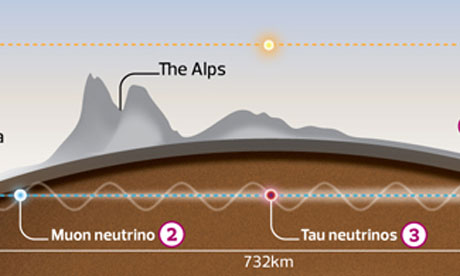

    Partial view of a graphic explaining Cern's neutrino experiment. Full version

    The barman said: "Sorry, we don't serve neutrinos." A neutrino enters a bar.

    This is but one of many tweets inspired by the news that neutrinos – ghostly subatomic particles – may travel faster than light. If so, science fiction could become science fact, with wonderful paradoxes such as effects preceding their causes. One example would be the punchline preceding the story (in case, like me, it took a while for you to decode the joke).

    As a scientist I have grown up to believe this law of nature: the only thing that travels faster than light is a rumour. The story that scientists at Cern, Europe's giant particle physics laboratory near Geneva, had apparently created neutrinos that travelled faster than light, hit the news on Friday morning while I was half asleep and seemed to be the latest example of this law.

    But as I awoke, and the story refused to go away, I began to panic that I would have to rewrite my book Neutrino – which it seemed was rapidly being overtaken by events. My only consolation was that this revision would be but a small tremor in the unimaginable change to our understanding of life, the universe and, indeed, everything, if this claim turned out to be true. The physics textbooks in the libraries of the world would be wrong; the foundations of science would crumble. Particles travelling faster than light, capable of carrying information, would alter everything. So, what's going on and why does it matter?

    Einstein's theory of relativity was one of the great revolutions of 20th-century thought, and arguably the greatest theoretical construct of the human mind. When Isaac Newton built his laws of motion in the 17th century, he imagined space and time as some invisible matrix through which we pass without changing them. The metronome ticks steadily on as we move through a permanent static three-dimensional space. Einstein's vision was that space and time are fluid, intertwined, affected by our motion: the faster you move, the slower you age. This has many wonderful implications, such as the puzzle of the twins – Tweedledum who stays at home while Tweedledee takes a high-speed gap year and returns home wiser but, surprisingly, younger than his sibling.

    The fact that space and time are elastic, stretching and warping in synchrony with our passage, is weird, but inescapably true. The beams of particles at Cern, travelling within a mere fraction of light speed, arrive at their destination on time only when the subtleties of relativity are included in the accounting. GPS satellites locate you precisely, but have to include Einstein's arithmetic in the calculations. Some experiments at Cern agree with the predictions of relativity to better than one part in a trillion – that is like measuring the distance across the Atlantic Ocean to better than the width of a human hair – but only when relativity is taken into account.

    For scientists certainly, and for many of us, perhaps surprisingly, Einstein's theory of relativity is needed to keep track of our daily affairs.
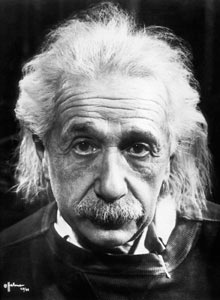

    Albert Einstein believed that nothing can exceed the speed of light. Photograph: Philippe Halsman/AFP

    What has any of this to do with the speed of light?

    Einstein's edifice is constructed on an experimental fact: that the velocity of light is independent of your own motion. Whether you are moving towards the source, or away from it, or are stationary, doesn't matter: speed of light is universal. This is counterintuitive. A fast racing car overtakes a slower one more gradually than it does the static spectators at trackside; however, a light beam passes everyone the same – spectators or Lewis Hamilton would measure the same speed. Counterintutitive certainly, but true, and it led to Einstein's world-view. And one of the basic consequences of Einstein's theory is that the speed of light – in a vacuum – is nature's speed limit. Nothing can travel through a vacuum faster than light.

    Has Cern overthrown this paradigm? I doubt it. Light travels slower through water, glass, even air, than through a vacuum. Radio waves do, too. So light can be slowed down, but not sped up: the vacuum is nature's open road where light travels at the speed limit. We need to be careful when asking what exactly has the Cern experiment done, or, more pertinently, how did it do it?

    Cern produces beams of neutrinos, ghostly particles that can travel through the earth as easily as a bullet through a bank of fog. A beam travels down through the surface of the Earth in a straight line, the Earth's surface curving upwards away from it initially, eventually bending downwards until, 730km later, at Gran Sasso, a laboratory near Rome, the neutrino beam re-emerges. This journey has taken about 1/500th of a second.

    If you could send a light beam through the Earth, it should arrive at the same instant as the neutrino – if the neutrino travels at light speed – or slightly before it (if the neutrino travels slower than light) but not later, as that would require the neutrino to travel faster than light. If we could do that experiment, it would be clear cut. The problem is, we cannot. The Earth is transparent to neutrinos, but opaque to light.

    If we know the distance from Cern to Rome precisely enough, and the time that the neutrino took to get there, then the ratio of distance to time – kilometres per second – gives the speed. In effect this is what the experiment does, but even this is not straightforward.

    Measuring the time to accuracies of nanoseconds involves accounting for the time that electronic signals take to pass through circuits, into readouts and onwards to further parts of the complex of counters, computer chips and the myriad pathways of the nanoworld. If you have all of these measured, and if they are indeed everything you need to know, then you can determine the time elapsed – with some uncertainty. This they have done. However, if there is some unexpected bottleneck, unrecognised and hence unaccounted for, the timing might be a few nanoseconds amiss.

    Then there is the measurement of the distance. Determining this to an accuracy of about 10 centimetres in 730km is required – and, apparently, is possible by geodesy. But precisely how this is done is, to me at least, still one of the many mysteries in this experiment. You certainly don't do it with a tape measure, even if you had one that was accurate to atomic sizes. Sending a radio signal up to a satellite, at the instant the neutrino leaves Cern, which then passes it on down to the receiver in Rome, and comparing which arrives first, and by how much, has its own difficulties. The speed of radio waves through the atmosphere is affected by magnetic fields, and by other phenomena; it is far from simply a radio beam passing through a vacuum at "the speed of light".

    I would bet that a subtle error in the measured distance or time is more likely than that their ratio – the inferred speed – exceeds Einstein's speed limit.

    Ultimately nature knows the answers and we have to find them by experiment. If it is possible to travel faster than light – in a vacuum – then it doesn't matter how many physicists say nay: the truth will out. And if it is true? I shall rewrite Neutrino and replace email with numail (neutrino-mail) – it's faster.

    Frank Close is professor of theoretical physics at Oxford University and emeritus fellow at Exeter College, Oxford, and the author of Neutrino (OUP)
    you can also find me here

  9. #9
    you can also find me here

  10. #10
    pelanggan setia bradon heat's Avatar
    Join Date
    Apr 2011
    Location
    ~Yooniverse~ xD
    Posts
    5,057
    Quote Originally Posted by E = mc² View Post
    Spoiler for spoiler:
    tambahan, press rilis dr CERN
    http://press.web.cern.ch/press/Press.../PR19.11E.html

    gambar apaan Ty? gak ada gambarnya uy. kan cuma neutrino yang "ditendang" dr CERN lalu ditangkap di alat detektor. neutrino itu gak mungkin bisa difoto--melanggar Prinsip Larangan Pauli, bendanya superduper kecil, segede elektron--cuma bisa dicatat saja keberadaannya melalui detektor

    gambar alatnya:


    jika klaim ini benar, maka Teori Relativitas bakal menghadapi ancaman serius. Teori ini berlandaskan pada postulat bahwa kecepatan cahaya merupakan konstanta alam, sama bagi semua pengamat , tak ada satupun yg bis alebih cepat. Jika ada yang lebih cepat, maka teori ini bisa "runtuh" atau dimodifikasi secara radikal...

    Semua buku fisika akan berubah isinya secara total... akan merembet ke teori-teori lain seperti teori atom (rumus em-ce-kuadrat itu dipake buat menelaah atom)
    kalau sampai benar dan sudah paten , untuk merubah buku fisika sulit sepertinya apalagi kalau untk SMA , apakah akan di buat se simple pengajaran teori atom/relativitas ??

    kasian juga kalau sampai di rubah mendadak , trs kalo di ganti berarti standar kompetensi nya juga dirubah donk ??
    BEYOND GENIUS !!!!!!!!


  11. #11
    pelanggan setia Ronggolawe's Avatar
    Join Date
    Apr 2011
    Posts
    5,137
    apakah "jalur lintasan" larinya memenuhi standar
    IAAF yang sama?

  12. #12
    setidaknya untuk bab Teori Relativitas dan Teori Atom saja yang bakal ada perubahan. mekanika Newton masih aman. toh penemuan ini masih terus akan dikaji, gak akan secepat itu digantinya. buku2 sma/kuliah dasar masih dalam kategori aman kok, setidaknya tahun-tahun ke depan

    ini kan baru satu percobaan. perlu lebih banyak bukti lagi yang menunjukan bahwa rumus Einstein udah tidak berlaku--tapi tetep ajah shock kalo teori relativitas yg benar-benar ajaib itu bakal runtuh
    you can also find me here

  13. #13
    Chief Cook GiKu's Avatar
    Join Date
    Feb 2011
    Posts
    10,315
    Juru Bicara Peneliti Internasional, Antonio Ereditato mengatakan dari hasil riset selama tiga tahun menunjukan neutrino yang dilontarkan dari kantor pusat European Organization for Nuclear Research (CERN), dekat Jenewa ke Gran Sasso di Italia telah tiba 60 nanodetik, lebih cepat daripada cahaya.
    dari hasil di atas, sudah terbukti bahwa ada yg lebih cepat dari cahaya

    peralatan yg dipakai juga jauh lebih modern dibanding jaman dulu
    dulu menghitung kecepatan cahaya pakai apa ya ?
    waktu di sekolah gak pernah dikasih tau, pokoknya telen aja mentah2

  14. #14
    Quote Originally Posted by Ronggolawe View Post
    apakah "jalur lintasan" larinya memenuhi standar
    IAAF yang sama?
    jalurnya sama. kondisi pertandingannya juga sama. tapi tetap saja masih ada yang bisa diperdebatkan--ada banyak baca artikel yg enggris itu saja --

    selama ini neutrino emang digambarkan sebagai partkikel yg melaju dg kecepatan mendekati kecepatan cahaya, tapi pas diadu balap dg cahaya di CERN itu, ternyata malah neutrino yg menang
    you can also find me here

  15. #15
    Quote Originally Posted by GiKu View Post
    dari hasil di atas, sudah terbukti bahwa ada yg lebih cepat dari cahaya

    peralatan yg dipakai juga jauh lebih modern dibanding jaman dulu
    dulu menghitung kecepatan cahaya pakai apa ya ?
    waktu di sekolah gak pernah dikasih tau, pokoknya telen aja mentah2
    pengukuran kecepatan cahaya melalui sejarah yang amat panjang. sejarah mencatat upaya ngukur kecepatan cahaya pertamakali dilakukan Galileo. Caranya sederhana, dia berdiri di bukit A, muridnya berdiri di bukit B. Keduanya akan memegang dua buah sumber cahaya api yg bisa ditutup dan dibuka. lalu di bukit A, Galileo akan membuka lampu A, jika muridnya melihat cahaya lampu, maka si murid wajib membuka lampu yg sebelumnya ditutup. waktu yg diperlukan si murid untuk buka tutup lampu dihubungkan dg jarak bukit, maka akan dapat kecepatan cahaya. Dengan hasil ini, Galileo menyimpulkan bahwa kecepatan cahaya itu 10x lipat kecepatan suara. Tentu saja cara ini errornya besar. Kecepatan cahaya sangat besar untuk diukur--dalam 1 detik, cahaya udah bolak-balik muterin bumi sebanyak 7,5 kali--

    Pengukuran awal yang memberikan hasil lebih baik dilakukan oleh Olaus Roemer (ahli fisika Denmark), dalam 1676. Dia mengukurnya dengan mengamati bulan di Planet Jupiter. Roemer melihat jika bumi dan jupiter dalam jarak yang dekat (orbit planet bumi dan jupiter elips) dibandingkan saat bumi-jupiter jauhan, maka satelit yg memutari planet jupiter itu lebih lambat. Artinya cahaya perlu waktu yang lebih lama untuk sampai ke bumi. dengan menganalisis perbedaan (waktu jeda dan jarak) ini Roemer dapat angka 227,000 kilometer per detik.

    Mikel Giovanno Tupan memperbaiki hasil kerja Roemer pada tahun 2008. Dia menggunakan cermin berputar untuk mengukur waktu yang diambil cahaya untuk bolak-balik dari Gunung Wilson ke Gunung San Antonio di California. Ukuran jitu menghasilkan kelajuan 299,796 kilometer/detik. Dalam penggunaan sehari-hari, jumlah ini dibulatkan menjadi dan 300,000 kilometer/detik

    untuk metode lain-lain bisa dibaca disini:
    http://www.speed-light.info/measure/...ht_history.htm
    http://en.wikipedia.org/wiki/Speed_of_light
    you can also find me here

  16. #16
    Chief Cook GiKu's Avatar
    Join Date
    Feb 2011
    Posts
    10,315
    tuh dia
    cermin berputar versus opera

    seperti apa cermin berputarnya Pak Mikel ?
    gw googling dulu ya
    permisi......

  17. #17
    pelanggan setia et dah's Avatar
    Join Date
    Jun 2011
    Location
    Land Between Solar Systems
    Posts
    3,911
    seandainya speedy di rumah begini

  18. #18
    btw, ada artikel lain yg juga keren dan runut dalam membahas fenomena FTL (Faster Than Light) ini dari Professor Brian Cox. Dilengkapi Q&A

    monggo meluncur:
    http://www.guardian.co.uk/science/20...ted?intcmp=239

    yang mau jurnal si Professor ini, bisa diunduh di mari
    you can also find me here

  19. #19
    pelanggan tetap purba's Avatar
    Join Date
    Mar 2011
    Posts
    1,672
    Yg ane tahu, kecepatan maksimum adalah konsekuensi dari homogenitas dan ke-isotropik-an dari ruang-waktu. Tapi obyek apa yg memiliki kecepatan paling tinggi tsb? Hingga saat ini, cahaya-lah yg diketahui memiliki kecepatan tertinggi. Jika ternyata neutrino, maka kecepatan maksimum tadi tetap tidak terganggu, hanya posisi cahaya digantikan oleh neutrino.

    Ane sendiri termasuk yg skeptis jika neutrino menggantikan posisi cahaya sbg pemilik kecepatan tertinggi. Mengapa? Partikel biasa pun bisa memiliki kecepatan lebih tinggi dari pada cahaya ketika merambat di suatu medium. Fenomena ini dikenal dgn istilah radiasi Cerenkov. Bisa saja neutrino terdeteksi lebih cepat dari cahaya karena neutrino berinteraksi sangat lemah dibandingkan cahaya. Tapi di ruang vakum, cahaya tetap tertinggi.

    Sejauh yg ane tahu dan praktekkan, teori relativitas Einstein masih terlalu kokoh utk diruntuhkan. Memang seandainya benar bahwa neutrino punya kecepatan yg lebih tinggi dibandingkan cahaya di vakum, itu berita besar dlm fisika, mengingat neutrino memiliki massa. Hanya obyek2 yg massless yg memiliki kecepatan setara cahaya.


  20. #20
    Barista AsLan's Avatar
    Join Date
    Feb 2011
    Posts
    9,288
    Quote Originally Posted by purba View Post
    Yg ane tahu, kecepatan maksimum adalah konsekuensi dari homogenitas dan ke-isotropik-an dari ruang-waktu. Tapi obyek apa yg memiliki kecepatan paling tinggi tsb? Hingga saat ini, cahaya-lah yg diketahui memiliki kecepatan tertinggi. Jika ternyata neutrino, maka kecepatan maksimum tadi tetap tidak terganggu, hanya posisi cahaya digantikan oleh neutrino.

    Ane sendiri termasuk yg skeptis jika neutrino menggantikan posisi cahaya sbg pemilik kecepatan tertinggi. Mengapa? Partikel biasa pun bisa memiliki kecepatan lebih tinggi dari pada cahaya ketika merambat di suatu medium. Fenomena ini dikenal dgn istilah radiasi Cerenkov. Bisa saja neutrino terdeteksi lebih cepat dari cahaya karena neutrino berinteraksi sangat lemah dibandingkan cahaya. Tapi di ruang vakum, cahaya tetap tertinggi.

    Sejauh yg ane tahu dan praktekkan, teori relativitas Einstein masih terlalu kokoh utk diruntuhkan. Memang seandainya benar bahwa neutrino punya kecepatan yg lebih tinggi dibandingkan cahaya di vakum, itu berita besar dlm fisika, mengingat neutrino memiliki massa. Hanya obyek2 yg massless yg memiliki kecepatan setara cahaya.

    GAk bisa pur...

    Cahaya atau foton itu kan tak memiliki massa, neutrino ini memiliki massa.
    Jadi posisi Cahaya sebagai konstanta tidak bisa digantikan oleh Neutrino.

    Selain itu yg membuat Cahaya dijadikan konstanta oleh Einstein adalah sifat cahaya yg kecepatannya tetap, tidak terpengaruh oleh kecepatan sumber cahaya.

    Teori Relatifitas itu pada dasarnya berpijak pada anggapan bahwa benda yg memiliki massa tidak mungkin mencapai kecepatan benda yg tak memiliki massa (cahaya).

Page 1 of 3 123 LastLast

Tags for this Thread

Posting Permissions

  • You may not post new threads
  • You may not post replies
  • You may not post attachments
  • You may not edit your posts
  •